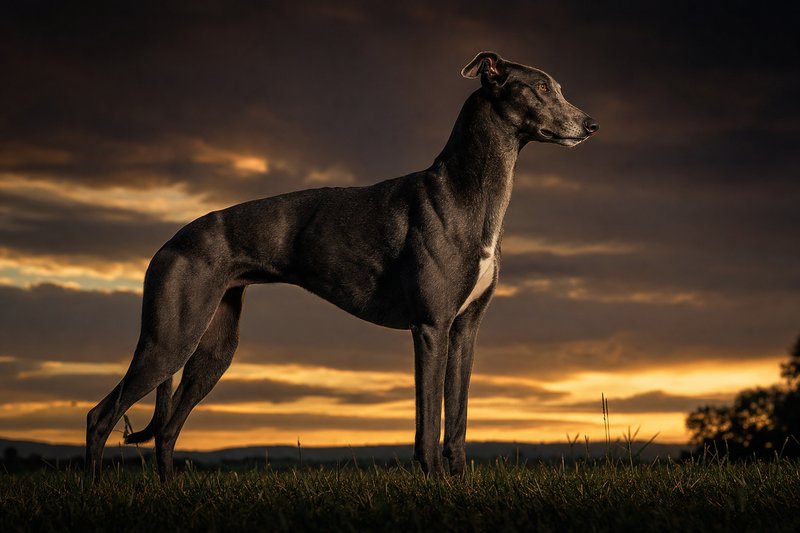
Greyhound Physiology: Built for Speed
A racing greyhound is a purpose-evolved sprint machine. Every major anatomical feature contributes to velocity, and the combination produces a dog capable of accelerating from a standing start to over 70 km/h (45 mph) in a matter of seconds — a rate of acceleration that outpaces most production cars over the same distance.
The deep chest and cardiovascular system
The greyhound's most immediately obvious feature is its deep, narrow chest. This cage houses a heart that is proportionally far larger than in other breeds — approximately 1.73% of body weight compared to around 0.77% in other dogs of similar size. The enlarged heart pumps an exceptional volume of oxygenated blood per stroke, which is why greyhounds can sustain maximum output through a sprint race without the kind of rapid cardiovascular fatigue seen in other breeds. During full racing effort, heart rate climbs to approximately 300 beats per minute.
Alongside the heart, the greyhound's lungs are large relative to body mass. Total oxygen intake and processing capacity is among the highest of any land animal relative to size. The combination of heart and lung capacity means greyhounds can sustain near-maximum speed for the duration of a standard race distance (300m–500m) rather than fading dramatically in the final stretch as a less aerobically efficient animal would.
The flexible spine
At top speed, a greyhound uses a "double-suspension gallop" — a gait in which all four feet leave the ground twice per stride cycle. This is only possible because the greyhound's spine flexes dramatically during movement. On the compression phase of the stride, the spine contracts; on the extension phase, it springs outward, effectively extending the dog's reach and adding several centimeters to each stride. Combined with long leg levers, this produces a stride length that can reach 5 meters — one of the longest of any animal relative to body size.
Lean build and muscle composition
Racing greyhounds carry between 27 and 32 kg of body mass, almost all of it lean muscle. Body fat percentage in a fit racing greyhound is typically 1%–3% — comparable to elite human athletes. The muscle fiber composition is also unusual: a high proportion of fast-twitch fibers optimized for explosive, short-duration output rather than sustained endurance. This is why greyhounds excel at sprinting but are not suited to long-distance endurance work.
Greyhound Temperament
The greyhound's athletic profile belies a notably calm temperament. Despite being capable of extreme speed, greyhounds are described by owners and breed experts as gentle, quiet, and affectionate. They are not typically high-energy in a domestic setting — greyhounds are known for spending large parts of the day resting, which has earned them the nickname "the 40 mph couch potato."
This calm temperament is partly the result of selective breeding for focus and controllability on the track. A greyhound trained to chase a mechanical lure needs to be calm and manageable in the kennel and the paddock. Dogs with an anxious or aggressive baseline temperament are poorly suited to the routine of a racing yard, and over generations, the breed has developed a mild-mannered default disposition.
Related Sighthound Breeds
The greyhound belongs to the sighthound family — dogs that hunt by sight and speed rather than by nose and stamina. Several related breeds share the greyhound's streamlined build and are relevant context for simulation game players who encounter these types in virtual racing products.
Italian greyhound
The Italian greyhound is a toy breed weighing 3–5 kg — roughly one-eighth the size of a racing greyhound. Bred as a companion animal for centuries, it shares the greyhound's narrow head and long legs in miniature form. Italian greyhounds do not race in organized track events and are not a model for any racing simulation profile, despite the name overlap. Encountering "Italian greyhound" in a simulation context is uncommon; when it appears it usually refers to a track location rather than a breed.
Whippet
The whippet sits between the Italian greyhound and the full-sized racing greyhound in scale, weighing 10–20 kg. Developed in northern England in the 19th century as a racing and coursing dog affordable to working-class communities, the whippet was raced over short straight tracks in an event known as "snap racing." Today, whippet racing continues as an amateur sport in several countries. A handful of simulation games include whippet-class virtual races, typically modeled as shorter and slightly less fast than standard greyhound events.
Saluki and Afghan hound
The saluki and Afghan hound are older sighthound breeds from the Middle East and Central Asia. While they share the greyhound's lean profile and sighting-based hunting style, they are not track racing dogs and do not appear in simulation games. They are relevant as genetic ancestors — studies suggest the greyhound and saluki share deep evolutionary roots as purpose-bred speed animals.
Retired Racing Greyhounds as Companion Animals
Racing greyhounds typically compete between the ages of two and four years, after which most are retired. Dedicated adoption organizations in the UK (Greyhound Trust), Ireland (GSPCA), Australia (GAP — Greyhound Adoption Program), and the United States (GREY2K) work to place retired racers in permanent homes.
The retired racing greyhound has become one of the most successfully rehomed ex-working-breed dogs in the world. Their calm temperament, moderate exercise requirements, and gentle behavior with children have made them popular with a wide range of adopters. Many simulation game players who have developed an interest in the breed through virtual racing ultimately seek out more information about adoption — a pathway that numerous advocacy groups actively support.
From Real Breed to Virtual Profile: How Simulation Games Use This Data
Greyhound simulation game designers do not create virtual dogs arbitrarily. The numerical attributes assigned to each virtual animal — sprint rating, stamina score, cornering ability, consistency rating — are calibrated against real-world greyhound physiology data to produce results that feel authentic.
A virtual dog with a high sprint rating but low stamina score replicates the profile of a real fast-twitch-dominant greyhound that performs brilliantly over 300m but fades in longer races. A virtual dog with high cornering and consistency scores replicates a rail-running, technically adept greyhound that handles tight bends well. These profiles are not fictional inventions — they are abstracted versions of real breed traits, translated into the parameters a probability engine can use.
For players, this means that the real-world knowledge covered in this guide has direct application in simulation games. Understanding that greyhounds are sprint-optimized, that their bend performance depends on agility rather than raw speed, and that the best animals combine cardiovascular capacity with lean, flexible bodies gives players a framework for interpreting virtual dog profiles beyond the numbers. For more on how this connects to race performance, see the greyhound speed guide and the greyhound racing game guide.