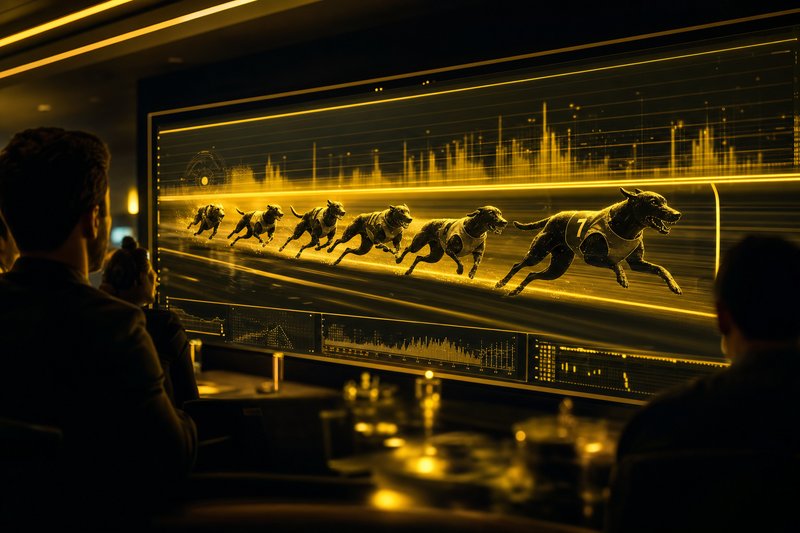
What Virtual Dog Racing Actually Is
Virtual dog racing is a software simulation. The game generates a complete race card — dogs with names, simulated form histories, trap positions, and probability-weighted odds — then produces a result using a random number generator. The outcome is rendered as a short animated race, typically 28 to 35 seconds, before the next card is presented.
There are no real greyhounds involved. There is no live track, no kennel, no training regime. Every element — the dogs, their speed profiles, their "form", the track layout, the weather condition flags — exists entirely within the simulation's data model. It is, in essence, a sophisticated probability game wearing the aesthetic of a sport.
This distinction matters because it shapes how players should approach the game. Strategies that work for real greyhound racing (watching warm-up behaviour, reading coat condition, understanding real-world track surfaces) have no direct equivalent in a pure simulation. What does transfer is the analytical layer: reading form data, understanding probability and odds, and recognising trap position effects — but applied to simulated data rather than live intelligence.
How the RNG Drives Race Outcomes
The random number generator is the engine at the heart of every virtual race. Before the race begins, the simulation allocates a portion of the 0–1 probability space to each dog, proportional to its assigned win probability. A dog with a 40% chance of winning occupies 40% of that space. A 10% dog occupies 10%.
When the race fires, the RNG draws a number. Whichever dog's probability segment that number falls within becomes the winner. The same process runs for second and third place, drawing from the remaining probability space with the winner removed.
The key property of this system is that each race is statistically independent. The RNG does not "remember" what happened in previous races. A favourite that has lost five races in a row has exactly the same probability of winning the next race as it would if it had won five in a row. This is a fundamental feature of the simulation model, not a bug — it ensures long-run statistical fairness while keeping individual races unpredictable.
For a deeper technical look at the algorithm behind this process, see the virtual dog racing algorithm explained guide.
How Odds Are Set in a Simulation
Odds generation is one of the more interesting mechanical layers in virtual dog racing. In a well-designed simulation, odds are not arbitrary — they are derived from the simulated attributes of each dog in the race.
The process typically works as follows:
- Each dog has a base speed rating built into its profile, representing its simulated ability level.
- Recent form figures (finish positions from prior virtual races) modify this base rating up or down.
- Track-specific factors — distance, bend tightness, surface conditions — apply a further modifier to each dog based on its simulated running style.
- Trap position modifiers are applied if the simulation models trap bias for the loaded track.
- The resulting adjusted ratings are converted into win probabilities and then formatted as fractional or decimal odds.
One consistent feature across simulation odds: the implied probabilities across all six dogs always sum to more than 100%. This built-in margin — called the overround in real racing — is standard practice in virtual sports design. It is not a flaw; it is the structural model the games are built on.
For a detailed breakdown of how to read and use odds in-game, the virtual greyhound racing odds guide covers the topic in full.
What Players Can and Cannot Influence
One of the most useful things to understand about virtual dog racing is the precise boundary between what is and is not under a player's control.
What you cannot influence: the outcome of any given race. The RNG fires the moment the race starts, and nothing the player does affects which probability segment it lands on. There is no strategy that changes the result of an individual race.
What you can influence: your selection. The race card gives you real data — form figures, odds, trap positions, track type — and the quality of your analysis of that data determines the quality of your selection over many races. Better selection habits do not guarantee wins in individual races, but they produce better expected outcomes in aggregate.
This is why experienced players focus on the process of selection rather than on outcomes. A good pick that loses is still a good pick. A poor pick that wins is still a poor pick. The simulation is large enough that quality of process shows through in the long run.
Virtual vs. Real Greyhound Racing: Key Differences
Virtual dog racing draws its visual and structural language from real greyhound racing, but the two are fundamentally different in several important ways:
- Availability: Real races happen at scheduled times at licensed tracks. Virtual races run continuously, 24 hours a day, every 3–5 minutes, with no dependency on weather, track conditions, or dog availability.
- Variables: Real racing involves dozens of unpredictable physical variables — a dog's mood, the temperature, track surface condition, proximity interference mid-race. Virtual racing only has the variables the simulation model has been programmed to include.
- Form data: In real racing, form data reflects actual athletic performance. In virtual racing, it reflects the simulation's generated history for that dog profile. The numbers look the same; their source is entirely different.
- Knowledge transfer: Understanding trap statistics, reading odds, and interpreting form figures all transfer from real to virtual and back — the analytical framework is shared, even though the underlying data is not.
- Speed of play: A real race meeting unfolds over several hours with long waits between races. A virtual meeting offers a race every few minutes with no downtime.
Why Virtual Dog Racing Works as a Game Format
The format's popularity stems from a combination of factors. The simulation provides genuine analytical depth — reading a race card and making a reasoned selection is a skill that develops with practice. The short race cycle creates a satisfying loop: card → decision → race → result, repeating every few minutes. And the sport aesthetic — the greyhound track, the traps, the form card format — gives the game a sense of heritage and context that pure abstract probability games lack.
Players who engage with the analytical layer find that their selection quality improves noticeably across a few sessions of deliberate practice. That feedback loop — noticing how your decisions are working and adjusting — is the core of what makes virtual dog racing more than just watching numbers randomise.
To start building that analytical layer, the greyhound racing game guide covers all the card-reading basics. For strategy that builds on those foundations, see the dog racing game strategy guide.