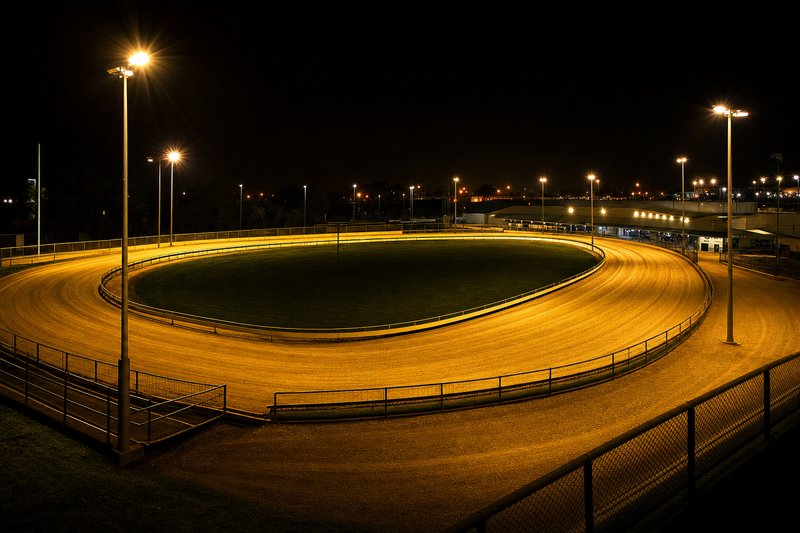
How Real Greyhound Tracks Are Designed
A greyhound racing track is an enclosed oval, typically between 400m and 550m in circumference for the standard racing surface. The oval consists of two straight sections — the home straight (where the finish line sits) and the back straight — connected by two bends. The shape of those bends, measured by their radius, is one of the most consequential variables in track design.
A tight bend radius (a sharper curve) demands more agility from dogs and tends to favor animals that can hold a tight racing line without losing momentum. A generous bend radius (a more gradual curve) suits dogs with higher top-end speed because they can maintain their stride more freely through the turn. Track designers balance these considerations with practical constraints: the amount of land available, the desired race distances, and the need to provide spectators with sightlines to the entire circuit.
Key track measurements
- Circumference: Typically 400m–550m for standard UK tracks. Determines the available race distances.
- Track width: Usually 8–10m across the racing surface. Wider tracks reduce crowding and decrease inside-trap advantage.
- Bend radius: Measured at the center of the racing line. Tighter radii create sharper bends and greater centrifugal force on the dogs.
- Straight length: Longer straights favor acceleration and pure speed; shorter straights place more weight on cornering ability.
Famous Real-World Tracks and Their Characteristics
Three venues stand out as particularly influential in the history and design of greyhound racing, and each has characteristics that game designers have drawn on when building virtual tracks.
Wimbledon Stadium, London
Wimbledon was the flagship greyhound venue in England for much of the 20th century. Its track was famously tight, with relatively sharp bends and a standard race distance of 480m. The tight configuration meant inside traps (Traps 1 and 2) enjoyed a measurable positional advantage — a characteristic many simulation games replicate as their "tight oval" preset. Wimbledon closed in 2017 for redevelopment, but its track dimensions remain a reference point in both the real sport and the simulation game world.
Wentworth Park, Sydney, Australia
Wentworth Park is Australia's most prestigious greyhound racing venue and home to the Group 1 Golden Easter Egg, one of the sport's richest sprint prizes. The track features more generous bends than most UK circuits and a wider racing surface, which reduces inside-trap dominance. Sprint races at Wentworth run over 520m; longer staying contests cover 720m. Simulation games modeled on Australian-style tracks typically show more distributed trap-win statistics — a useful contrast for players who have only experienced UK-style simulations.
Shelbourne Park, Dublin, Ireland
Shelbourne Park is the home of the Irish Greyhound Derby, the most prestigious race in Irish greyhound sport. The track's 400m sand circuit is known for favoring pace — dogs that break fast from the traps and establish an early position on the rail. This characteristic is reflected in simulation games based on Irish-style tracks: early speed matters more than sustained stamina, and trap draws carry significant weight in probability calculations.
Track Shape and Trap Bias in Simulation Games
Trap bias — the tendency for certain trap positions to produce more winners — is one of the most practically useful concepts in greyhound simulation play, and it derives directly from track geometry.
On a tight oval, the dog in Trap 1 (inside rail) has the shortest path through the first bend. From the starting boxes to the first bend, all six dogs run roughly the same distance. But as they enter the bend, the Trap 1 dog can take a tighter line and emerge from the corner in a better position relative to the others without having covered more ground. Over many races, this geometric advantage accumulates into a statistically observable bias.
Simulation game designers reproduce this effect by assigning a "bend penalty" to wider trap numbers — the wider the trap, the more simulated ground covered through the first corner. On tight oval settings, this penalty is steep; on wide-track or straight-track settings, it approaches zero.
Typical trap-bias patterns in simulation games
- Tight oval (Wimbledon-style): Traps 1 and 2 significantly favored in sprint races. Trap 6 disadvantaged.
- Standard oval (Shelbourne-style): Traps 1 and 2 mildly favored. Traps 4 and 5 neutral to slightly disadvantaged.
- Wide oval (Wentworth-style): Bias flatter. Fast-breaking dogs in any trap can establish a good position.
- Straight track: No bend bias. Trap position has minimal effect; raw speed dominates.
Straight Tracks: The Rare Alternative
A small number of greyhound venues use straight tracks rather than ovals. Straight racing eliminates bend dynamics entirely — dogs run in a direct line from start to finish, and the mechanical lure travels in a straight course ahead of them. At a straight track, trap bias effectively disappears: every dog covers the same distance over the same terrain.
In simulation games, straight-track races are unusual but present in some platforms. They are generally easier to analyze because the form guide and speed ratings dominate the probability calculation without bend-position adjustments. New players sometimes find straight-track simulation modes a useful starting point because one variable (trap position) is essentially removed from the equation.
Surface Type and Its Simulation Equivalent
Real greyhound tracks use one of several surface types: sand (most common in UK and Ireland), synthetic sand, or grass (used at some Australian venues). Surface conditions affect grip, pace, and how dogs perform in wet conditions. A wet sand surface slows times noticeably; dry, firm sand produces faster races.
More sophisticated simulation games model surface as a variable. A "wet track" setting may reduce the statistical advantage of pace dogs (those that prefer firm surfaces and fast early fractions) and slightly favor dogs profiled as better in slower conditions. This adds another layer of pre-race analysis for players who pay attention to track condition settings. For further background on how the physical characteristics of greyhounds interact with track surfaces, the greyhound speed guide covers the biomechanics in detail.
How This Knowledge Transfers to Your Game
When you load a simulation game and see a track selection screen, you are now equipped to make sense of it. A tight oval with a 400m circumference favors inside traps — adjust your selection strategy accordingly. A wide, long-straight track distributes probability more evenly — rely more heavily on form and speed ratings and less on trap number. The trap numbers guide and the greyhound racing game guide build on this foundation with specific strategy recommendations for each track type.