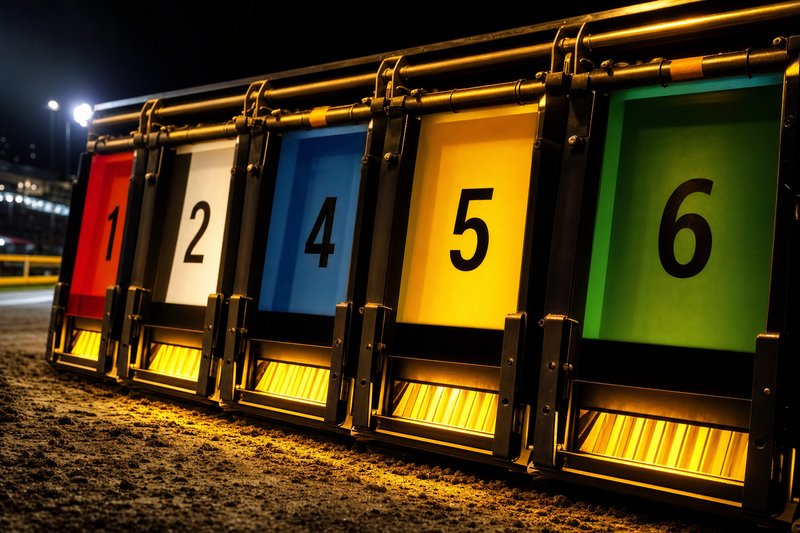
What Trap Numbers Represent
In any greyhound race — real or simulated — six starting boxes (traps) are arranged side by side at the starting line. Trap 1 is positioned on the inside rail, closest to the infield. Trap 6 is on the outside, furthest from the rail. Each trap is colour-coded, and these colours remain consistent across every track and simulation that follows standard greyhound racing conventions:
- Trap 1 — Red: Inside rail. Shortest arc around every bend.
- Trap 2 — Blue: Just outside Trap 1. Near-rail position with good early position potential.
- Trap 3 — White: Middle-inside. Balanced position offering both rail access and racing room.
- Trap 4 — Black: Middle-outside. Similar balance to Trap 3, often considered the most neutral position.
- Trap 5 — Orange: Near-outside. Must negotiate traffic from inside dogs on bends.
- Trap 6 — Black and white stripes: Outside rail. Longest arc, most distance, least rail protection.
The trap number is displayed prominently on every race card. Learning to read the colour coding in race animations helps you track individual dogs through the race rather than just watching the field move as a mass.
How Starting Position Affects Race Outcomes in Simulations
The impact of trap position on race outcome is driven by track geometry. The key variable is bend tightness — how sharp the corners are relative to the length of the straights.
On a standard circular track, the inside rail dog (Trap 1) runs the shortest possible path from start to finish. Every dog further out runs a proportionally longer arc around every bend. Over 480 metres with multiple bends, this distance differential is meaningful. On a perfectly circular track with a 480m circumference, the difference in race distance between Trap 1 and Trap 6 is approximately 10–12 metres — a gap that translates to roughly 0.2–0.3 seconds at greyhound speeds.
That distance advantage only fully converts to a win advantage if the Trap 1 dog can hold its rail position. The inside rail also creates the highest risk of interference on the first bend — every dog in traps 2–6 is trying to establish position and the inside dog is at the intersection of all those trajectories. Dogs that break slowly from Trap 1 are often crowded.
Trap Performance by Track Shape
Track shape is the primary variable in determining which traps are advantaged. The three most common track shapes in simulation games map to distinct trap bias profiles:
Tight Circular Tracks
Short straights, sharp bends, multiple turns. These tracks maximise the inside rail advantage. Trap 1 wins approximately 18–19% of races (compared to the 16.7% expected from six equal-probability positions). Trap 6 is most disadvantaged here — the wide outside line on tight bends means the dog runs significantly longer distances and must negotiate traffic through every turn.
On these tracks, Traps 1 and 2 are the strongest positions. Traps 5 and 6 require exceptionally fast dogs to overcome the positional disadvantage.
Wide Oval Tracks
Longer straights, more gradual bends. The inside rail advantage is substantially reduced because all six dogs can carry near-maximum speed through gentler curves. Trap 6 on a wide oval runs at approximately 14–15% win rate — still slightly below the theoretical equal of 16.7%, but the gap is narrower than on tight tracks.
On wide ovals, middle traps (3 and 4) tend to be most consistent because they access the racing room of both lanes. Fast early-breaking outside dogs can also perform well because the wide bend geometry allows them to establish position without losing significant ground.
Straight Sprint Tracks
Some simulation games include straight-track sprints (typically 270–330m). Without bends, there is no inside rail advantage from geometry. All six traps start roughly equal. The variation that exists in straight track results comes primarily from first-stride explosiveness — how quickly dogs break from the trap — rather than positional geometry.
On sprint tracks, form and speed rating are more deterministic than trap position. Middle traps (3 and 4) are very slightly preferred because they give dogs the most room to move in either direction off the line, but the effect is small compared to bend tracks.
How Simulation Games Replicate Real-World Trap Statistics
Well-designed simulation games replicate real-world trap bias through a modifier system applied before odds are generated.
The process typically works as follows:
- The game loads a track type (tight circular, wide oval, straight sprint).
- Each trap number is assigned a probability modifier for that track type. Trap 1 might receive a +1.5% modifier on tight tracks; Trap 6 might receive a -1.5% modifier.
- These modifiers are applied to each dog's base win probability before the odds are calculated and displayed on the race card.
- The resulting odds reflect both the dog's form and the trap position modifier — a strong dog in a disadvantaged trap might be priced more similarly to a weaker dog in an advantaged trap than its raw ability would suggest.
This means the race card already incorporates trap bias into the displayed odds in a well-designed simulation. What you see as "8/1" for a Trap 6 dog versus "5/2" for a Trap 1 dog might partly reflect identical base ability ratings, with the odds difference driven by trap position rather than form.
Understanding this means you can look for cases where a dog's odds appear high relative to its form, and assess whether the trap position explains the price — or whether the odds are genuinely reflecting an underperforming dog. The former might represent a value selection; the latter usually does not.
Running Styles and Trap Suitability
Beyond geometry, trap position interacts with a dog's simulated running style — how early or late in the race it reaches peak speed, and whether it favours the rail or prefers wide racing room.
A fast-starting dog (reaches full pace within the first 50m) benefits most from inside traps — it can establish rail position before the field converges. A dog with a slower early pace but strong late finishing speed may actually perform better from wider traps, where it can avoid the first-bend scrimmage and accelerate into clear racing room.
Higher-fidelity simulations model these running style tendencies in their dog profiles. The form card might show whether a dog is a fast-breaking rails runner or a wide-running finisher. Matching running style to trap position — rails dog in Trap 1 or 2, wide runner in Trap 4 or 5 — is a key advanced strategy that rewards close reading of the form card.
Building Your Own Trap Statistics
Many simulation games include a track statistics screen showing historical trap win rates. If yours does, use it — this is directly actionable data that tells you how the game's probability engine is calibrating trap bias for each virtual venue.
If the game does not include this feature, you can build your own table. Over 50 races at a single virtual venue, record the trap number and finish position for every race. After 50 races, the pattern should be clear enough to give you working estimates of which traps the game engine is favouring at that venue.
This is exactly the kind of deliberate observation that distinguishes experienced simulation players from casual players who simply pick a dog and watch. The investment of 50 recorded races pays dividends across every future session at that venue.
For how trap statistics connect to the broader race card analysis framework, see the complete beginner's guide. For the full strategy context — how to combine trap reading with form analysis and odds interpretation — the strategy guide is the reference. For how the RNG interacts with these probability modifiers to produce race outcomes, see the virtual dog racing explained guide.