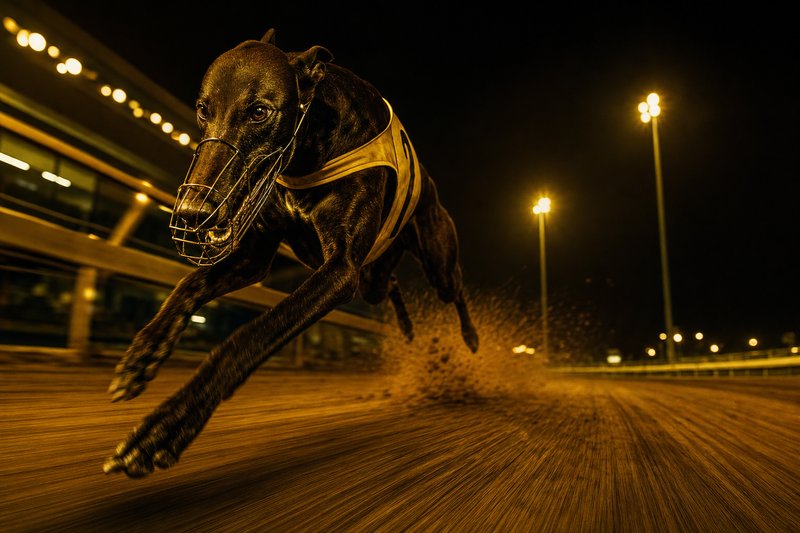
How Greyhound Racing Simulation Games Work
At their core, greyhound racing simulation games are probability engines dressed in sport clothing. Before each race, the game assigns each of the six dogs a weighted probability of finishing in each position. These weights are expressed as odds on the race card. When you hit the start button, a random number generator fires and produces a result consistent with those probabilities — favourites win more often than outsiders, but not always.
The simulation loop is built to feel like a real race meeting. You see the card, make your selection, watch a short race animation lasting roughly 28–35 seconds, see the result, and move on to the next event. Most games run virtual meetings continuously, with a new race available every few minutes. The speed of the cycle is one of the things that makes simulation games so engaging — there is always another race around the corner.
Understanding that the game's engine is probabilistic — not predetermined — is the first mental shift new players need to make. No outcome is fixed in advance. Each race is an independent event. A dog that has won its last five simulated races is not "due" to lose, and a dog that has lost its last five is not "due" to win. The RNG resets every time.
Reading the Race Card
The race card is the information screen shown before each event. Learning to read it fluently is the single most important skill in any greyhound racing game. Every card contains the same core data points:
- Trap number: The starting box, numbered 1 (inside) to 6 (outside). Colour-coded in most games — red for 1, blue for 2, white for 3, black for 4, orange for 5, black-and-white stripes for 6.
- Dog name: Usually generated randomly in simulation games, sometimes drawn from databases of real greyhound names for authenticity.
- Form figures: A sequence of digits showing finishing positions in recent races, read right-to-left for newest-first. A form of 1-1-3-2 means the dog won its last two races, placed third and second before that.
- Best time or speed rating: Many games include a personal best time over the distance, useful for comparing raw pace.
- Odds: The probability weighting expressed as a fraction (e.g. 5/2) or decimal (e.g. 3.50). Lower odds indicate the simulation engine considers the dog more likely to win.
Spend the first few sessions just reading cards without worrying about results. Get comfortable scanning from trap to form to odds in one smooth pass. That fluency pays off when races run back-to-back quickly.
Understanding Trap Numbers in the Game
Trap position is not cosmetic. In well-designed simulations, it meaningfully affects probability outcomes based on the track shape loaded for that race. This mirrors what happens in real greyhound racing, where inside rails on tight bends create traffic and outside traps on wide tracks offer cleaner lines.
On tight circular tracks, Trap 1 is often slightly advantaged — the dog on the inside rail has the shortest path to the first bend. On wider, more oval layouts, Traps 3 and 4 tend to be more consistent because the dog avoids both rail congestion and the wide outside. Trap 6 on tight tracks is often the least preferred position.
Not every game models trap bias with the same depth. Simple casual games may treat all six traps equally. More sophisticated simulators include track-specific bias data that changes the probability weights. If the game you are playing has a stats or history section, check whether trap win rates are listed — that information directly changes how you should read a card.
For a deeper look at how each trap performs across different track shapes, see the full greyhound trap numbers explained guide.
What Odds Actually Tell You
Odds in a greyhound racing game are the game's built-in probability estimates translated into a betting-style display format. They do not guarantee anything about a single race, but they are meaningful as long-run probability signals.
Here is a quick conversion between fractional odds and implied probability:
- Evens (1/1): 50% implied win probability
- 2/1: 33% implied probability
- 5/2: 29% implied probability
- 4/1: 20% implied probability
- 10/1: 9% implied probability
When you see these figures across six dogs, notice that the total implied probabilities add up to more than 100%. That margin — called the overround — is baked into most simulation engines and mirrors how bookmaker prices work in real racing. It is not something you can exploit; it is simply part of the model.
What matters for gameplay is the relative comparison. Is the favourite at 6/4 genuinely stronger than the second favourite at 5/2, or are they close? When a dog is listed at 2/5 (very short odds), it is a strong favourite — but in a 6-dog race, strong favourites still lose often enough to keep every race interesting.
How to Pick Dogs: A Beginner Framework
New players often default to one of two extremes: always picking the favourite, or always picking an outsider for the excitement of a long-shot win. Both approaches miss the analytical layer that makes greyhound games genuinely rewarding.
A more structured starting framework:
- Step 1 — Scan form: Eliminate dogs with recent poor form (runs of 4s, 5s, 6s). Focus on dogs showing 1s and 2s in their last three runs.
- Step 2 — Check trap: On a tight-bend track, give Trap 1 a small advantage. Discount Trap 6 slightly. On straight tracks, treat traps as roughly equal.
- Step 3 — Compare odds: If two dogs both show good form, the one with lower odds has stronger probability backing from the engine. That is meaningful information.
- Step 4 — Look for value: A dog showing excellent recent form but priced at 5/1 or 6/1 is worth noting — it may be underpriced relative to its form.
This framework will not make you win every race — nothing does. But it gives you a consistent basis for decisions rather than guessing. Over many races, disciplined reading of the card produces better results than random selection.
Common Beginner Mistakes
Knowing what to avoid is just as useful as knowing what to do. These are the patterns that slow down new players most:
- Chasing a losing run: After several bad results, beginners often raise their stakes or switch to increasingly risky picks. The RNG does not "owe" you a win. Each race is independent.
- Ignoring form entirely: Treating every race as a random guess removes all the skill from the game. Form figures exist to inform decisions — use them.
- Only ever picking the favourite: Favourites win around 40% of simulated races. That means they lose 60% of the time. A strategy of blindly backing every favourite is statistically sub-optimal.
- Not tracking results: Many new players play without any record-keeping. Keeping even a simple log of picks and outcomes across 20–30 races reveals patterns in how well your selection method is working.
- Confusing in-game points with real money: Virtual racing games use in-game currency or points for scoring. These have no real-world value. The game is a simulation — treat it as a strategy and entertainment experience, not a financial one.
Getting Into the Rhythm of a Race Meeting
Simulation games are designed around the rhythm of a full meeting — a sequence of races at the same virtual venue. Each card you see in a meeting will reference the same dogs, which means you get to observe form developing in real time as the meeting progresses.
A dog that ran a strong second in Race 1 might start shorter odds in Race 3. A favourite that underperformed early in the meeting might drift to a longer price later. Paying attention to these mid-meeting odds shifts is one of the more advanced skills, but noticing them from your first session builds the habit of active observation.
Most games cycle through 8–12 races per meeting before resetting to a new card. At 28–35 seconds of race time plus a short card display, a full meeting takes around 15–20 minutes. It is a self-contained experience with a satisfying arc from first race to last.
For a broader look at how the simulation engine generates those outcomes, the virtual dog racing explained guide covers how RNG and probability weighting work together. When you are ready to take your approach to the next level, the dog racing game strategy guide builds on the basics here with more advanced methods. For quick pointers you can apply right away, see the dog racing game tips page.