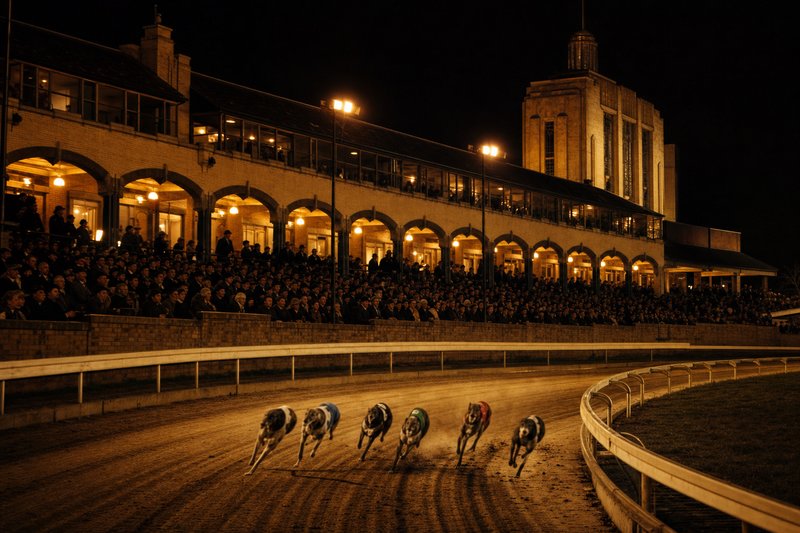
Ancient Origins: Coursing Before the Track
Long before oval tracks and starting boxes existed, humans were racing dogs across open terrain. Coursing — the practice of setting swift dogs to chase prey by sight rather than scent — is documented in Egyptian tomb paintings dating to around 2900 BCE. Greyhounds, or their direct ancestors, appear repeatedly in ancient imagery because their build made them uniquely suited to high-speed pursuit: a deep chest, a flexible spine, and a lean, aerodynamic frame.
In medieval England, coursing evolved into a formalized competition. By the 16th century, Queen Elizabeth I had Lord Norfolk draw up official coursing rules, creating the earliest documented framework for judging dogs in competitive pursuit. The Waterloo Cup, established in 1836, became the most prestigious coursing event in Britain and continued until 2005. These early structures — judging dogs on agility, turning ability, and speed — fed directly into the numerical rating systems that game designers later adopted for simulation dog profiles.
Owen Patrick Smith and the Mechanical Lure
The leap from open-field coursing to enclosed track racing required one critical invention: a mechanical substitute for live prey. Owen Patrick Smith, an American entrepreneur, spent years developing a reliable electric lure system. In 1919, he opened what is widely recognized as the first modern greyhound racing track in Emeryville, California, where dogs chased a motorized rabbit around a circular course.
Smith's design solved several problems at once. An enclosed oval track allowed spectators to watch the entire race from fixed stands. A mechanical lure produced consistent, repeatable race conditions. Starting boxes — later refined into numbered traps — gave each dog a fair, simultaneous start. The result was a sport that could be staged regularly, could accommodate multiple races per event, and could support a structured card of competitors much like a horse racing meeting.
Within a decade, Smith's model had been adopted across the United States, and entrepreneurs in Britain quickly recognized the format's commercial potential.
The Sport Reaches Britain and Ireland
The first licensed greyhound racing meeting in the UK took place at Belle Vue, Manchester, in July 1926. The sport expanded explosively: within two years, dozens of tracks had opened across England, Scotland, and Wales. The National Greyhound Racing Club (NGRC) was established to oversee licensing and standards, introducing the grading and handicapping systems that gave form guides their meaning.
Ireland followed a parallel path. The Irish Greyhound Board (Bord na gCon), founded in 1958, regulated racing and maintained the studbook that tracked breeding lineages. Shelbourne Park in Dublin and Curraheen Park in Cork became flagship venues, each with its own track dimensions and bend characteristics that shaped how dogs from different trap draws performed.
Australia built one of the largest greyhound racing industries in the world, with Wentworth Park in Sydney emerging as the sport's marquee venue. Australian tracks tended to feature longer straight sections than their British counterparts, subtly altering the advantage conferred by different trap draws — a detail that simulation game designers replicate when modeling different "track types."
Key Milestones in Greyhound Racing History
- 1919: Owen Patrick Smith opens the first mechanical-lure track in Emeryville, California.
- 1926: Belle Vue, Manchester hosts the UK's first licensed meeting.
- 1927: White City Stadium, London, opens and becomes an iconic British venue.
- 1932: Wentworth Park, Sydney, opens in Australia.
- 1958: Irish Greyhound Board established, formalizing regulation in Ireland.
- 1970s: Photo-finish timing replaces manual judging; race data begins to be systematically recorded.
- 1990s: First computerized form databases emerge, making historical race data searchable.
- 2000s: Virtual greyhound racing products appear in gaming arcades and online platforms, borrowing the sport's statistical framework.
Track Structure: How the Physical Sport Shaped Simulation Design
The physical design of a greyhound track — its circumference, bend radius, straight length, and surface material — has direct consequences for which dogs win. A tight bend rewards dogs with agility and the ability to hold a racing line; a long straight rewards pure acceleration. Trap draw matters because dogs breaking from wider traps must cover more distance on the first bend to reach the rail.
Game developers working on greyhound simulations studied real-world track data extensively. The six-trap system, the grading of dogs by recent performance, the way sectional times (the time a dog takes to reach each point of the course) reveal running style — all of these elements appear in virtual racing software because they were first refined on real tracks over a century of competition.
Historical Race Data and Virtual Racing Algorithms
One of the least visible but most important connections between the sport's history and modern simulation games is the use of historical race data to calibrate probability engines. When a game designer sets up a virtual greyhound racing product, they need the simulation's outcomes to feel statistically realistic — not random noise, but the kind of structured variance that real racing produces.
Real greyhound racing generates enormous amounts of data: finishing positions, trap draws, sectional times, track conditions, and win rates by trap. Decades of that data have been analyzed to establish baselines. Trap 1 (the inside rail) wins at a certain frequency across different track shapes. Favorites win at a certain rate. Front-runners hold their lead at a certain percentage. These historical frequencies are baked into simulation algorithms to produce races that feel authentic to players familiar with the real sport.
This is why the history of greyhound racing is not just sporting trivia — it is the raw material from which virtual games are constructed. Every time a simulation player reads a form guide or considers a trap draw, they are engaging with a system built on more than a century of recorded racing data.
The Simulation Era
By the early 2000s, software developers had recognized greyhound racing as an ideal candidate for computerized simulation. The sport's clear numerical structure — six dogs, numbered traps, measurable odds, defined distances — translated naturally into game mechanics. Unlike team sports, where dozens of variables interact in unpredictable ways, greyhound racing distills competition into a format that algorithms can model convincingly.
Early virtual greyhound games appeared in gaming terminals at amusement venues. As internet infrastructure improved, browser-based and then mobile versions emerged. Today, players can engage with greyhound simulation games that run hundreds of virtual races per day, each generated by probability engines that trace their design philosophy directly back to Smith's Emeryville track and the grading systems of the NGRC.
Understanding the sport's history makes players better at navigating these simulations. Knowing why trap bias exists, why form matters, and why distance preferences are real — even in a virtual context — gives players a richer framework for making selections and understanding results.