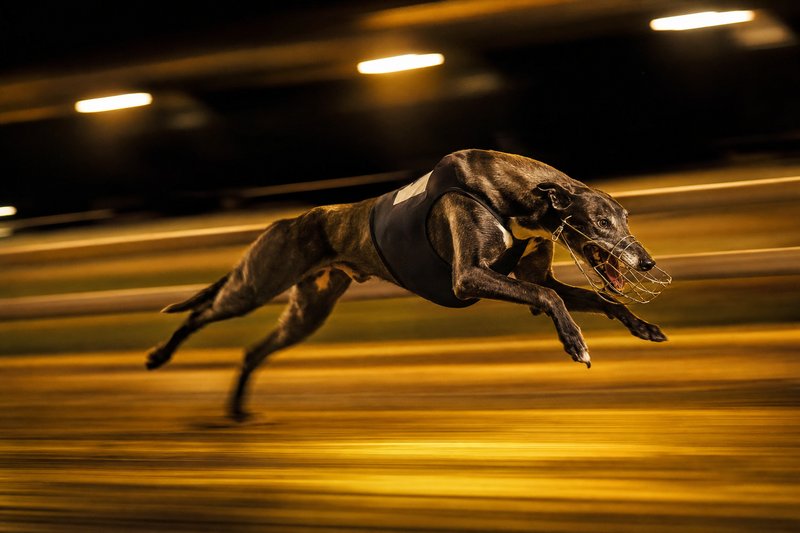
The Raw Numbers: Greyhound Top Speed
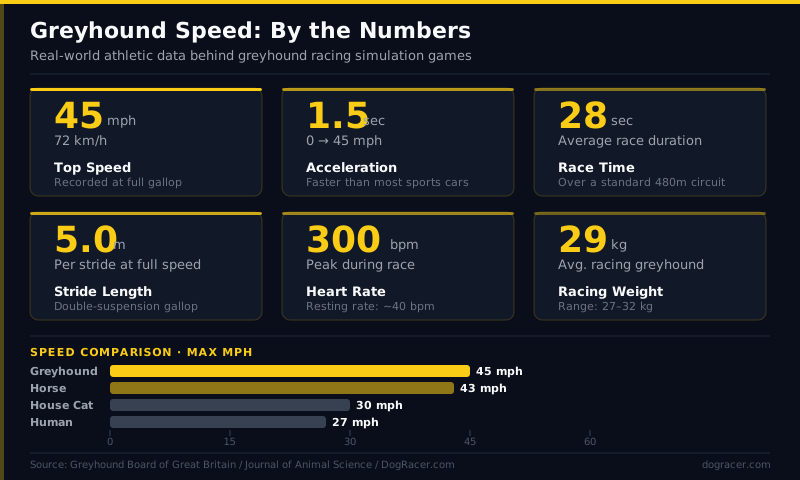
A racing greyhound's documented top speed is approximately 45 mph (72 km/h), recorded through speed trap measurements at professional greyhound tracks. Some exceptional animals have been clocked marginally higher in ideal conditions, but 45 mph represents the established benchmark for elite-level dogs.
To contextualise this: the average human sprinter reaches around 15–16 mph. Olympic-level sprinters peak closer to 27 mph. A greyhound runs nearly twice as fast as the fastest human alive, and reaches that speed faster.
At the standard race distance of 480 metres, elite greyhounds complete the course in approximately 28 seconds. Average track-grade dogs run closer to 30–32 seconds. The 4-second range across the performance spectrum is what simulation game developers use to calibrate their speed rating distributions.
Embed this graphic
The Physiology Behind the Speed
Greyhound speed is not an accident of selective breeding — it emerges from a specific combination of anatomical features that work together to produce extraordinary sprint performance.
The double-suspension gallop: Greyhounds use a gait called the double-suspension gallop, shared with cheetahs. In this gait, all four feet leave the ground twice per stride cycle: once when the legs are bunched beneath the body and once when fully extended. This dramatically extends effective stride length. A greyhound's stride covers around 4–5 metres at full speed — roughly 4–5 body lengths per stride.
The flexible spine: The greyhound's spine flexes dramatically through each stride, functioning like a coiled spring that stores and releases energy. This spinal extension is visible when watching a greyhound at full pace — the body arcs and stretches in a fluid wave motion that amplifies the leg power below it.
Cardiopulmonary capacity: Greyhounds have an unusually large heart relative to body size — approximately 1.18–1.73% of body weight versus 0.77% in non-athletic breeds. Their deep chest accommodates lungs with exceptional oxygen capacity. This enables rapid oxygen delivery to muscles during explosive sprinting, sustaining peak output over the full race distance.
Lean body composition: Racing greyhounds carry minimal body fat — typically 3–5%. Every kilogram of mass is either muscle or the structural systems that support it. This power-to-weight ratio is a fundamental contributor to their acceleration advantage.
Aerodynamic profile: The narrow head, slim waist, and tucked abdomen give greyhounds an unusually low drag profile at high speed. While air resistance at 45 mph is modest compared to a vehicle, in animal biomechanics it is a meaningful factor over a 480m distance.
Greyhound Speed vs. Other Animals
Placing greyhound speed in context of the animal kingdom reveals what makes the breed genuinely remarkable:
- Cheetah (70–75 mph / 112–120 km/h): The cheetah is faster, but maintains top speed for only 200–300 metres before decelerating due to thermal overload. A greyhound sustains near-peak speed for 480 metres.
- Thoroughbred racehorse (40–44 mph / 64–71 km/h): Racehorses are slightly slower to peak speed but sustain pace over much longer distances. Over the first 480m, a greyhound outpaces most racehorses.
- Whippet (35 mph / 56 km/h): The greyhound's smaller relative is fast but clearly slower. Whippets are occasionally featured in simulation games as a variant race type.
- Usain Bolt (peak ~27.8 mph / 44.7 km/h): The fastest human on record runs at about 60% of a greyhound's top speed.
- Quarter Horse (55 mph / 88 km/h over very short distances): The Quarter Horse actually exceeds greyhound speed over the first 100–200m but cannot maintain it. Over 480m the greyhound advantage is restored.
How Speed Data Feeds Into Simulation Game Design
Understanding real greyhound speed is directly relevant to simulation game players because well-designed games use these parameters as the foundation of their speed rating systems and probability models.
Simulation developers typically work backward from real-world race time distributions. If the recorded range across the performance spectrum runs from approximately 28 to 35 seconds over 480m, a simulation's speed ratings are calibrated to produce a similar distribution of outcomes. Elite virtual dogs are rated to produce times at the fast end; weaker virtual dogs produce times toward the slower end.
This means speed ratings in a simulation game carry real meaning. A dog rated at 85 (on a 1–100 scale) should be expected to run faster times than one rated at 65, in the same way an elite track dog consistently beats an average grade dog.
The practical implication for players: when a game displays a dog's best time or speed rating, those numbers are grounded in the same distribution as real greyhound performance. A dog showing the best recorded time in a race field has a genuine probability advantage — its speed rating translates directly into the odds generation model.
What Speed Means for Track Design in Simulations
Real-world greyhound tracks are designed around the breed's speed profile. The standard 480m distance is chosen to be long enough for a meaningful race but short enough that the dogs can sustain near-peak pace throughout. Tighter bends require deceleration on corners; wider bends allow dogs to carry more speed through turns.
Simulation games replicate these design parameters. A tight circular track with short straights and sharp bends reduces dogs' ability to use their maximum speed efficiently — cornering physics constrain the pace. A wide oval with longer straight sections allows dogs to reach and hold top speed more of the race.
This is why trap position matters differently across track types. On a tight bend, the inside rail dog has the shortest arc to navigate — but it also faces the highest risk of interference from the five dogs trying to establish position on the same corner. On a wide oval, the speed differential between inside and outside rail diminishes because the bends are gentle enough that all six dogs can carry near-peak pace through them.
For more on greyhound breeds that appear in simulation games, see the greyhound dog breeds guide. To understand how tracks are designed and modelled in simulations, the greyhound racing tracks guide has the detail. For how this speed data connects to game play in a racing simulation, the complete beginner's guide is the starting point. A look at the sport's longer history is available at the history of greyhound racing.